 うたぴょんスポーツ

Looking for a 1000m goal for your child, a real race to watch, or a glimpse of everyday training? Start here. I am Uta's dad, and this guide brings together our family's running records and experiences in Japan.
Sponsored
1000m split chart: a 3:30 example
A 1000m race is two and a half laps of a standard 400m track. For this 3:30 example, pass 400m in 1:24 and 800m in 2:48, then cover the final 200m in 42 seconds.
| Distance | Elapsed time |
|---|---|
| 200m | 0:42.00 |
| 400m | 1:24.00 |
| 600m | 2:06.00 |
| 800m | 2:48.00 |
| 1000m (finish) | 3:30.00 |
This is a calculation example, not an age standard or a recommended target. It assumes an even pace; it does not include the start or a finishing kick.
Open the 1000m split calculator with this goal →
Change the goal to your own time, compare the 200m and 400m checkpoints, and save a PNG split card for race day or share the result link with your coach.
A target, a training result and an official race result are different things. The articles below keep those distinctions clear. Japanese school grades are not the same as race age groups; Uta was seven in the 2023 practice and eight in the 2024 race featured here.
Choose where to start
Two 1000m results, with their context
| Date | Time | What it was |
|---|---|---|
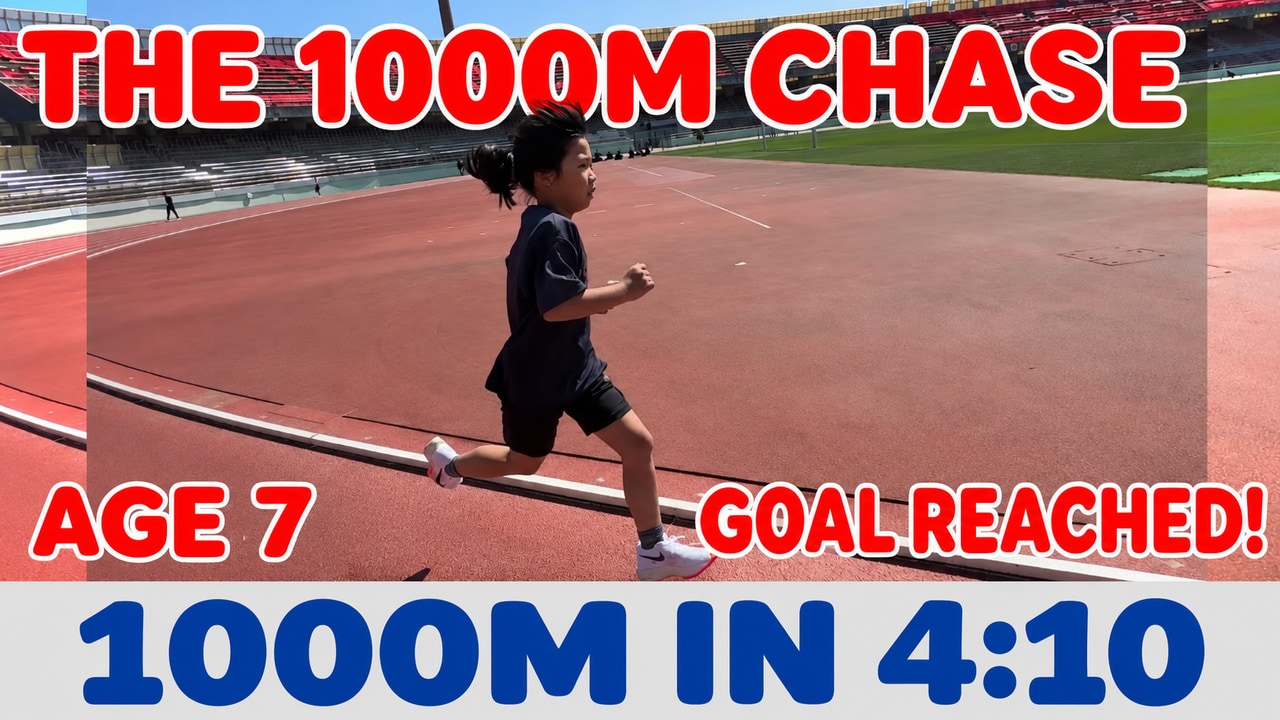
| 19 March 2023 | 4:10 | Club practice game, age seven |
| 23 March 2024 | 3:50.33 | Adachi meet, age eight |
The first was a practice result; the second was an officially recognised race result. They record different occasions, not a controlled comparison of training methods or an average for children.
Watch the Adachi 1000m race
Near the end of Japanese Grade 2, Uta ran 3:50.33 and won the girls’ Grades 1–2 division. Our target was 3:50: she finished just 0.33 seconds outside it. Watch the race to put a real performance alongside the goal table.
English subtitles are available: choose English in the player’s Subtitles/CC settings.
What the numbers can tell us
A goal is something our family hoped to reach. A result describes one run, with its own conditions. Neither tells us what every child should run. When reading our diary, the context matters as much as the stopwatch.
For a broader view, meet Uta and explore her race records, or discover how Japanese children’s ekiden relays differ from individual races.
The training week behind the race times
Beyond a race time, what does an ordinary week look like? Uta and one friend take Monday completely off; another friend does a slower recovery run. Their key workouts also fall on different days. Compare all seven days, then watch the MDC FINAL U-10 race video with English subtitles.